
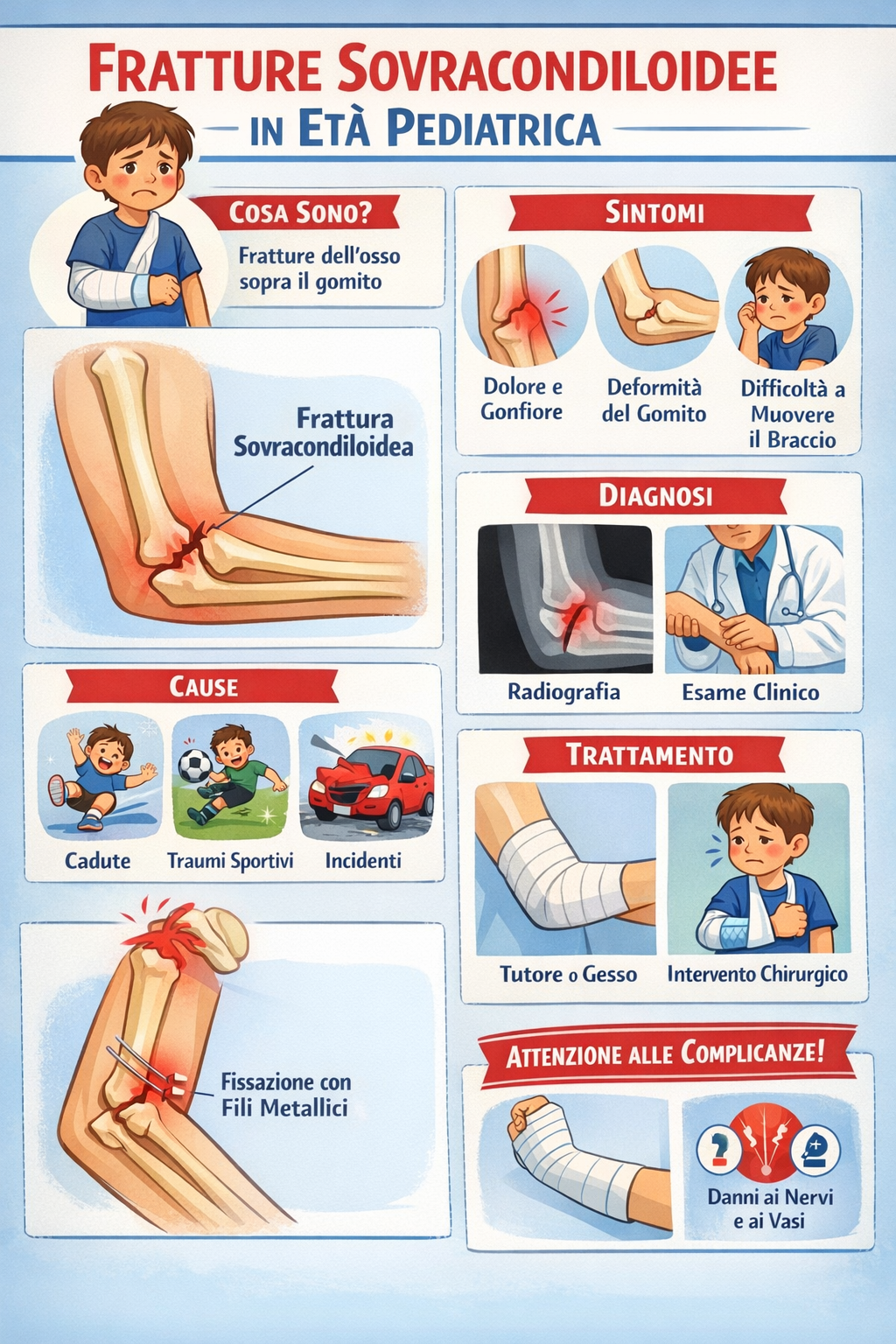
Supracondylar fractures of the humerus are one of the most common injuries in children, particularly between the ages of 4 and 10. They occur at the distal aspect of the humerus, just above the elbow, and are generally caused by a fall on an outstretched arm.
Causes and mechanism of trauma
The most common cause is a fall while playing or playing sports. In children, the bone is still growing and has structural characteristics that make it more vulnerable to this type of fracture. The typical mechanism is hyperextension, for elbow extension fractures (the most common) or flexion fractures (rarer), following a fall with the hand resting on the ground.
Based on the degree of decomposition, they are classified internationally according to the Gartland classification (classically divided into types I – III) .
Symptoms
The main clinical signs include:
-
Severe pain in the elbow
-
Swelling and possible deformity
-
Difficulty or inability to move the arm
-
Sometimes tingling or reduced sensitivity and/or mobility of the hand, if associated with vascular-nervous impairments (as sometimes occurs in the more complex ones).
In the most severe cases, where nerves and blood vessels may be involved, the indicated treatment is emergency/urgent.
Diagnosis
The diagnosis is based on clinical suspicion, which is confirmed by an X-ray of the elbow (and, if indicated, of other affected areas as well). The X-ray allows the fracture to be classified based on the degree of displacement, a key factor in deciding on treatment.
Treatment
Treatment depends on the severity of the fracture:
-
Displaced or slightly displaced fractures : immobilization in a plaster cast, with subsequent clinical and radiographic checks.
-
Displaced fractures : reduction (alignment of the bone fragments), which can be bloodless (with external maneuvers) or bloody (through surgical access), stabilization, often using metal Kirschner wires (percutaneous osteosynthesis), associated with immobilization.
In most cases, with timely and appropriate treatment, the prognosis is favorable and the child fully recovers elbow function.
Complications
Complications may include joint stiffness, residual deformity (such as varus elbow), and neurovascular lesions. For this reason, proper treatment and follow-up by a highly specialized orthopedic specialist are essential.
Related topic
Fratture nei bambini: perché guariscono diversamente rispetto agli adulti?