
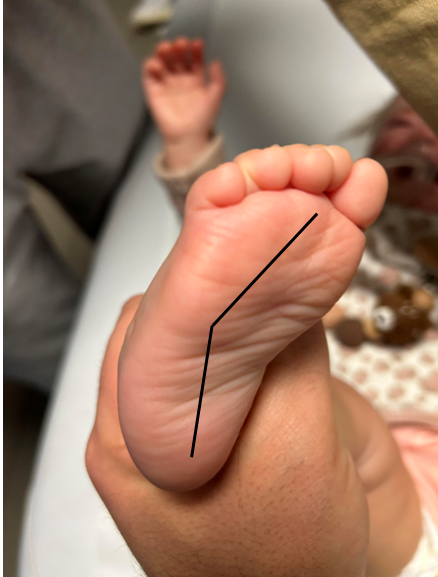
Metatarsus adductus is a deformity of the forefoot that is present from birth. The bones are tilted inward, giving the foot a characteristic C-shape.
Metatarsus adductus is the least severe form of congenital clubfoot. It occurs equally in males and females and affects both feet in half of cases.
It affects approximately 1-2 newborns in 1,000. The disorder primarily affects the metatarsals (the bones in the middle of the foot), which are excessively tilted inward (adducted).
As a result, the anterior (front) part of the foot deviates inward. In 2-4% of cases, especially in girls, it may be associated with developmental hip dysplasia, and therefore ultrasound screening is recommended. It can be diagnosed during a morphological ultrasound performed during pregnancy.
The causes
The cause of metatarsus adductus is unknown, but the disease often runs in families and can be present in parents or siblings.
The deformity is present at birth, with the front of the foot bent inward (adducted) but not downward or with the ankle turned inward as occurs in congenital clubfoot.
The foot is curved like a C, with the protrusion (convexity) toward the outside and the concavity toward the inside, with a characteristic fold (groove) in the central part (Figure 1). The big toe is more or less separate from the second toe and points inward.
When left untreated, metatarsus adductus causes the child to walk with his toes turned inward.
The diagnosis
This condition can be identified already during pregnancy during morphological ultrasound.
Confirmation occurs immediately after birth with an orthopedic examination: the forefoot, that is, the front part of the foot, appears adducted, the external part protrudes more due to the greater inclination of the last metatarsal (the fifth).
The cure
Skeletal abnormalities and their rigidity determine the degree of the deformity, allowing us to distinguish between more or less severe forms. In the mildest forms of metatarsus adductus—the vast majority—the foot is flexible and the deformity is easily corrected manually. These forms tend to heal spontaneously during growth, without the need for therapy or bracing.
In some cases, the correction can be accelerated by the specialist’s advice and by the parents themselves through gentle manipulations, performed several times a day by gently grasping the heel with one hand and applying pressure to the forefoot to correct the adduction.
For intermediate forms it is possible to apply specific braces (Bebax).
For the most severe cases of metatarsus adductus, i.e. with a rigid deformity that is difficult to correct manually, the application of a plaster cast may be appropriate.
Surgical treatment is very rarely necessary.
Once corrected, metatarsus adductus does not recur.