
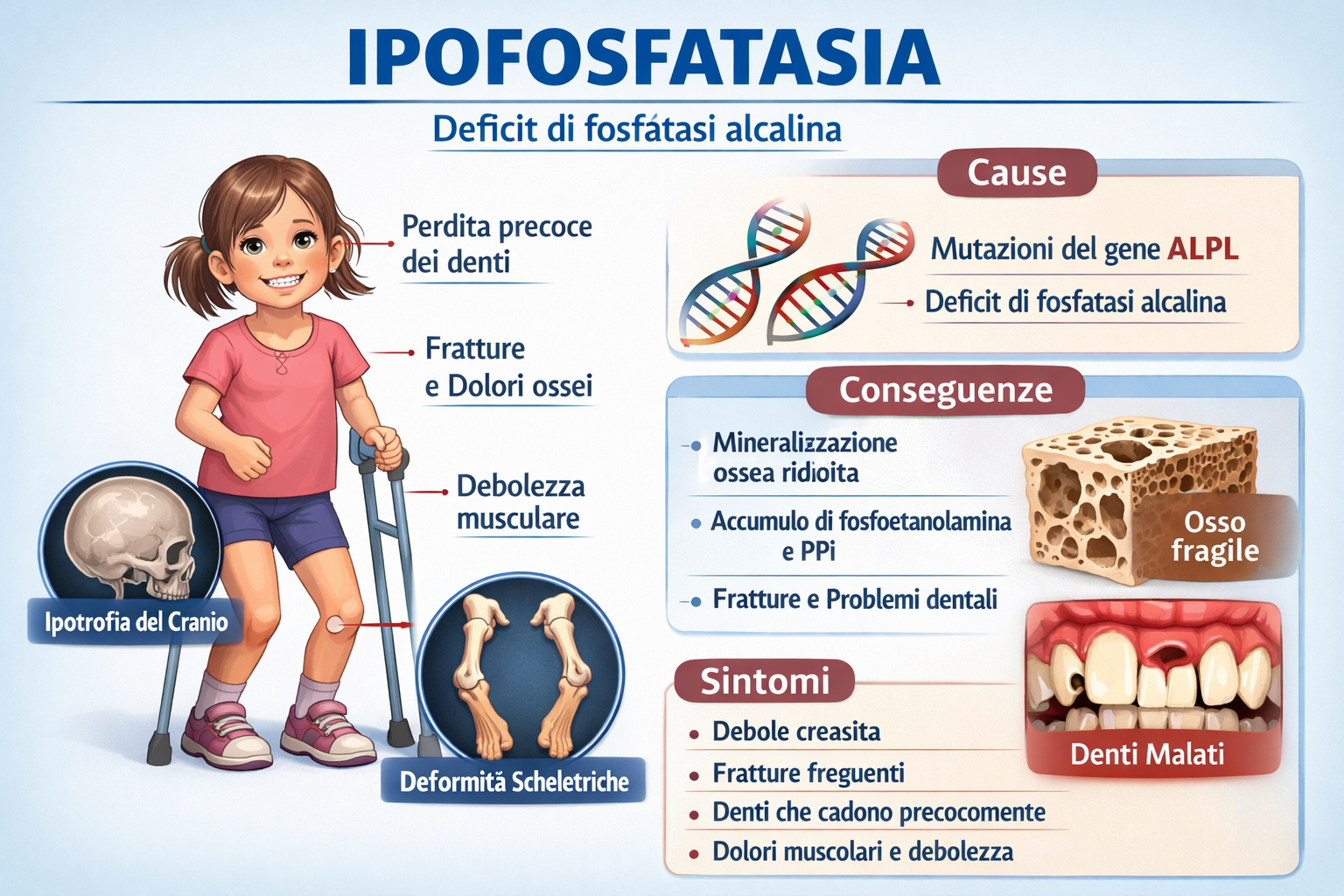
Hypophosphatasia (HPP) is a rare genetic disorder of bone metabolism caused by mutations in the ALPL gene, responsible for the production of tissue-nonspecific alkaline phosphatase. A deficiency of this enzyme impairs proper bone and tooth mineralization, making the skeleton more fragile, even in childhood.
Why it affects children’s bones
During childhood, the skeleton is undergoing rapid growth and remodeling. In hypophosphatasia, the accumulation of substances that would normally be broken down by alkaline phosphatase hinders the deposition of calcium and phosphate in the bone. The result is a condition similar to rickets, but of genetic and metabolic origin.
Pediatric orthopedic repercussions
🦴 Bone fragility and fractures
Children with HPP may experience recurrent fractures, sometimes even after minimal trauma. Long bones (femur, tibia) are particularly vulnerable. Fractures may heal slowly and with residual deformity.
📉 Delayed growth
Reduced mineralization compromises the solidity of the growth plates, with possible short stature or disharmonious growth.
🦵 Lower limb deformities
They are frequent:
- Bowed legs (varus) or “X” legs (valgus)
- Alignment changes in the knees and ankles
These deformities result from structural weakness of the bone during loading.
🪑 Pain and functional limitation
The child may complain of bone and muscle pain, tire easily, and have difficulty running or jumping. In more severe cases, walking may be delayed.
🦴 Changes in the rib cage
In the most severe cases (infantile forms), rib weakness can cause chest deformities and secondary respiratory problems.
🦷 Dental signs with orthopedic value
The early loss of baby teeth (with intact roots) is a typical sign and can be a warning sign of a systemic disease that also involves the skeleton.
Implications for orthopedic treatment
Orthopedic management requires a multidisciplinary approach:
- Monitoring limb growth and alignment
- Fracture prevention (adapted physical activity, aids if necessary)
- Orthopedic surgery when necessary, with caution due to reduced bone quality
- Collaboration with metabolic centers, because today there is an enzyme replacement therapy that can improve bone mineralization.
Related topics
L’intervento chirurgico di Epifisiodesi temporanea (“crescita guidata”)