
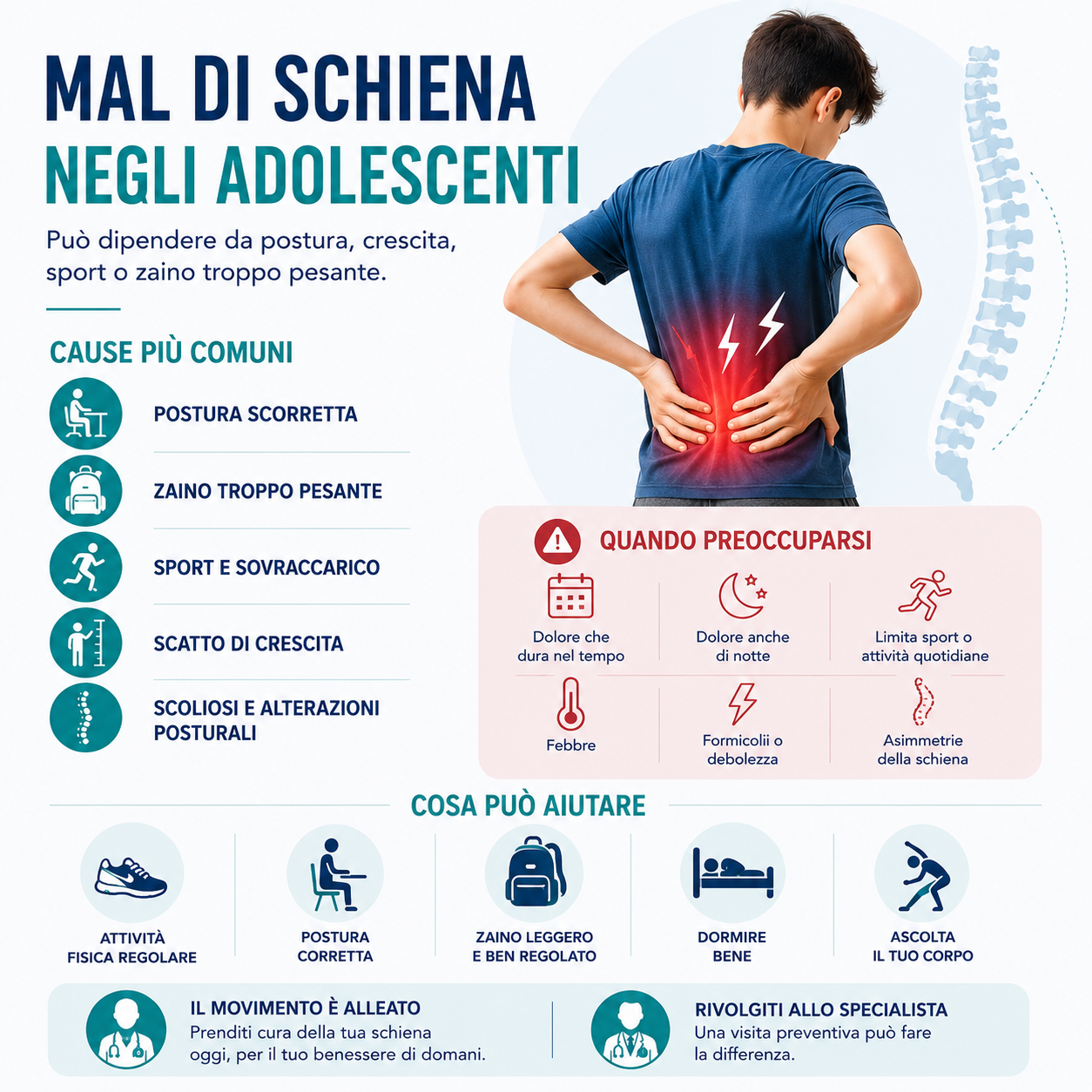
Back pain doesn’t just affect adults.
Even growing adolescents and children may experience back pain, especially during periods of rapid physical development or intense sports activity.
In most cases, the problem is benign and temporary, but some signs warrant attention and specialist evaluation, and as a general rule, persistent low back pain in children should always be investigated further.
Is back pain common in teenagers?
Yes. In recent years, back pain in adolescents has become increasingly common.
Possible causes include:
- rapid growth;
- incorrect postures;
- sedentary lifestyle;
- prolonged use of smartphones and computers;
- intense sporting activity;
- muscle overload.
Pain may affect:
- lower back (lumbago);
- the back;
- more rarely the neck.
What are the most common causes?
Incorrect posture
Many kids spend many hours:
- sitting;
- on the computer;
- with smartphones and tablets;
- in incorrect positions.
The so-called “screen posture” can increase muscle tension and spinal fatigue.
Backpack too heavy
An excessively heavy backpack can increase discomfort, especially in children who are already predisposed.
More than weight, what often matters is:
- the way it is transported;
- the extended time;
- the presence of bad posture.
Sports and overload
Sport is generally positive, but intense or repetitive training, especially if not combined with adequate athletic preparation, can cause:
- contractures;
- inflammations;
- spinal overload.
Some activities are more exposed:
- artistic gymnastics;
- dance;
- soccer;
- volleyball;
- weightlifting.
Growth spurt
During adolescence, bones and muscles grow rapidly and not always harmoniously.
This can cause:
- rigidity;
- muscle tension;
- temporary pain.
Scoliosis and spinal alterations
Back pain can sometimes be associated with:
- scoliosis ;
- hyperkyphosis ;
- postural alterations.
For this reason it is important to observe any asymmetries of the trunk.
When is pain not normal?
In most cases the pain is mild and transient.
However, a specialist evaluation is advisable if:
- the pain persists for weeks;
- it also appears at rest;
- wake the boy up at night;
- limits sports or daily activities;
- it is associated with fever;
- lameness appears;
- it is associated with loss of strength or sensation;
- it gets worse rapidly.
Do smartphones affect posture?
Yes.
Prolonged use of smartphones and tablets promotes:
- head tilted forward;
- closed shoulders;
- increased load on the cervical and dorsal spine.
These habits can contribute to muscle pain and fatigue.
What can help?
Regular physical activity
Movement is one of the most important tools.
They are useful:
- walk;
- I swim;
- postural exercises;
- stretching;
- personalized and regular athletic training activities, in athletes, especially competitive ones;
- muscle strengthening.
Improve posture
It may be useful:
- take frequent breaks while studying and playing video games;
- avoid sitting for many consecutive hours;
- use appropriate desks and chairs;
- limit bad postures with smartphones.
Check your backpack
The backpack should:
- be worn on both shoulders;
- don’t be overly heavy;
- have correctly adjusted shoulder straps.
Are X-rays needed?
Not always, sometimes radiographic examinations alone are not enough, second level examinations (MRI, CT) may also be indicated.
In most cases, mild back pain does not require immediate testing.
The findings are evaluated based on:
- duration of pain;
- clinical visit;
- age;
- any warning signs.
Is complete rest useful?
Usually not alone.
In the acute phase, it can certainly be useful, but unless specifically indicated, prolonged rest often tends to worsen stiffness and muscle weakness.
In most cases, moderate and controlled activity is preferable. The most important thing is to identify the cause of the pain.
When should you see a specialist?
A pediatric orthopedic visit is advisable if:
- the pain persists;
- the boy reduces sports activities;
- back asymmetries appear;
- the pain is frequent or severe;
- there are doubts about posture or growth.
Related topics