
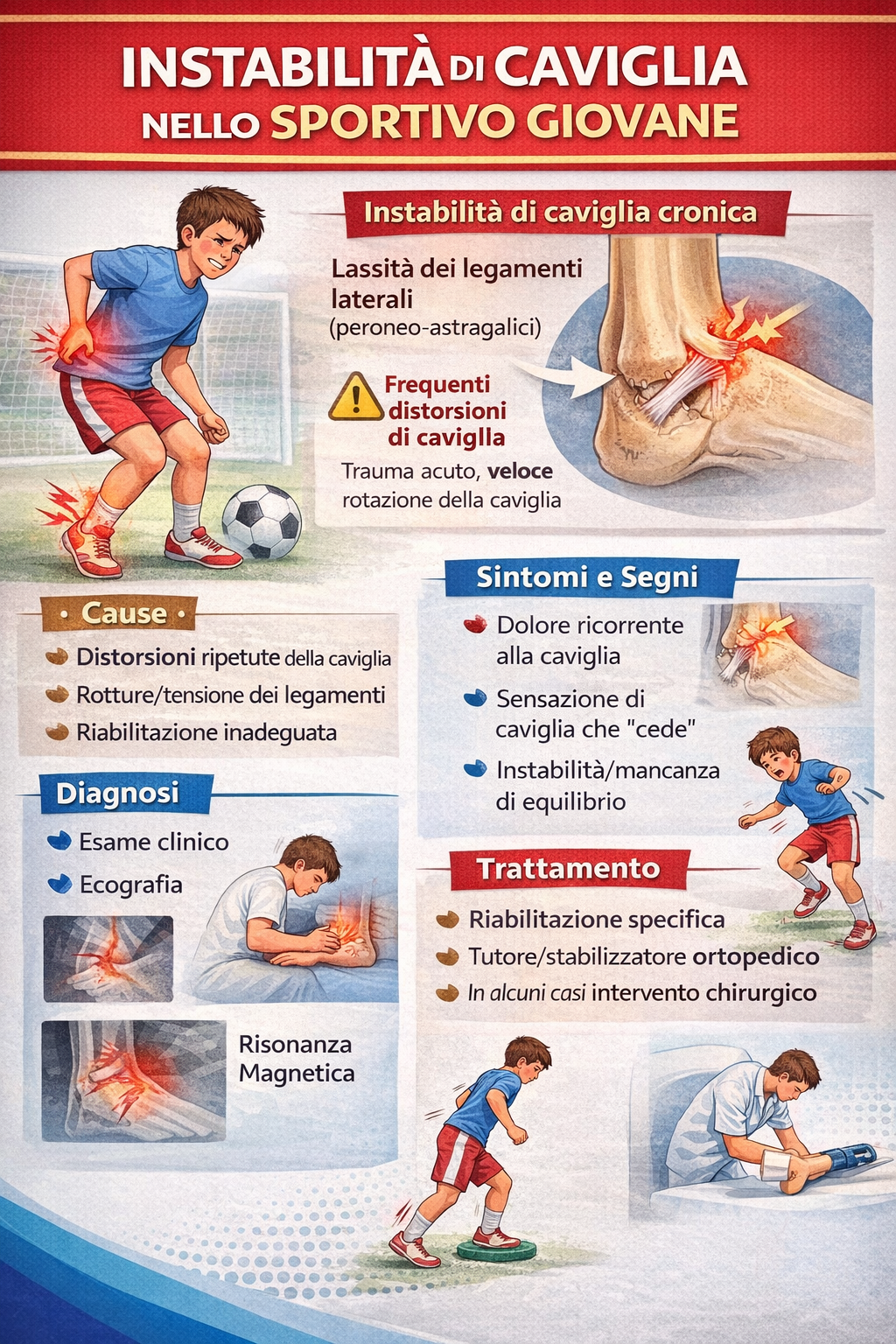
Ankle instability is a common condition among children and adolescents who participate in sports. It often results from repetitive sprains and can compromise athletic performance and increase the risk of further injuries. Early recognition and treatment are essential to prevent it from becoming a chronic problem.
What is ankle instability?
Ankle instability is a condition in which the joint loses its normal ability to maintain stability during movement , especially when changing direction and jumping.
It is generally linked to a laxity or lesion of the lateral ligaments of the ankle , in particular:
- anterior talofibular ligament
- calcaneofibular ligament
This condition can develop after one or more episodes of ankle sprain , especially if not treated adequately.
Main causes
The most frequent causes of ankle instability in young athletes are:
- repetitive ankle sprains
- incomplete healing of the ligaments
- inadequate or insufficient rehabilitation
- early return to sports activity
- deficits in balance and neuromuscular control
The most at-risk sports include:
- soccer
- basketball
- volleyball
- gymnastics
- athletics
Symptoms
Symptoms can be variable but often characteristic.
The most common are:
- recurring ankle pain
- feeling of instability or of the ankle “giving way”
- repeated episodes of distortion
- difficulty changing direction
- reduction in sports performance
In some cases the following may be present:
- intermittent swelling
- joint stiffness
- fear of movement (functional instability)
Diagnosis
The diagnosis is based on a highly specialized pediatric orthopedic evaluation .
Clinical examination
It is essential to evaluate:
- ligament stability
- pain on palpation
- joint mobility
- balance and motor control
Instrumental tests
The most commonly used tests are:
- Ultrasound : useful for studying the ligaments
- MRI/CT : evaluation of ligament injuries and associated structures and/or bone injuries (differential diagnosis with osteochondritis dissecans)
- X-ray : to exclude bone lesions or structural instabilities
Treatment
In most cases, treatment is conservative and very effective.
Functional rehabilitation
It is the cornerstone of treatment and includes:
- proprioception and balance exercises
- muscle strengthening (peroneals and stabilizers)
- recovery of joint mobility
- specific training for the sport practiced
Braces and bandages
They can be used:
- during sports activities
- in the early stages of recovery
They help improve stability and prevent new sprains.
Drug therapy
Anti-inflammatory drugs can be used in acute painful phases, but they do not represent the solution to the problem.
When surgery is necessary
Surgery is indicated only in a minority of cases, when:
- instability persists despite adequate rehabilitation
- sprains are frequent and disabling
- there is a significant ligament injury
Surgical techniques aim to reconstruct or stabilize the lateral ligaments of the ankle.
Prognosis and return to sport
With proper treatment, the prognosis is very good .
Most young athletes:
- fully recovers stability
- return to sport without limitations
- significantly reduces the risk of recurrence
The return to sport must be gradual and guided , after complete recovery of strength, balance and motor control.
Prevention
Prevention is essential, especially for young athletes.
The most effective strategies include:
- proprioception exercises
- muscle strengthening
- use of braces in subjects at risk
- correct rehabilitation after each sprain
When to see a specialist
An orthopedic evaluation is advisable when:
- repeated distortions occur
- the ankle feels unstable
- the pain persists over time
- sport becomes difficult or limited
An early diagnosis allows for effective treatment and avoids the progression towards chronic instability .
Related topics
Osteocondrosi: le patologie dell’osso in crescita e del giovane sportivo